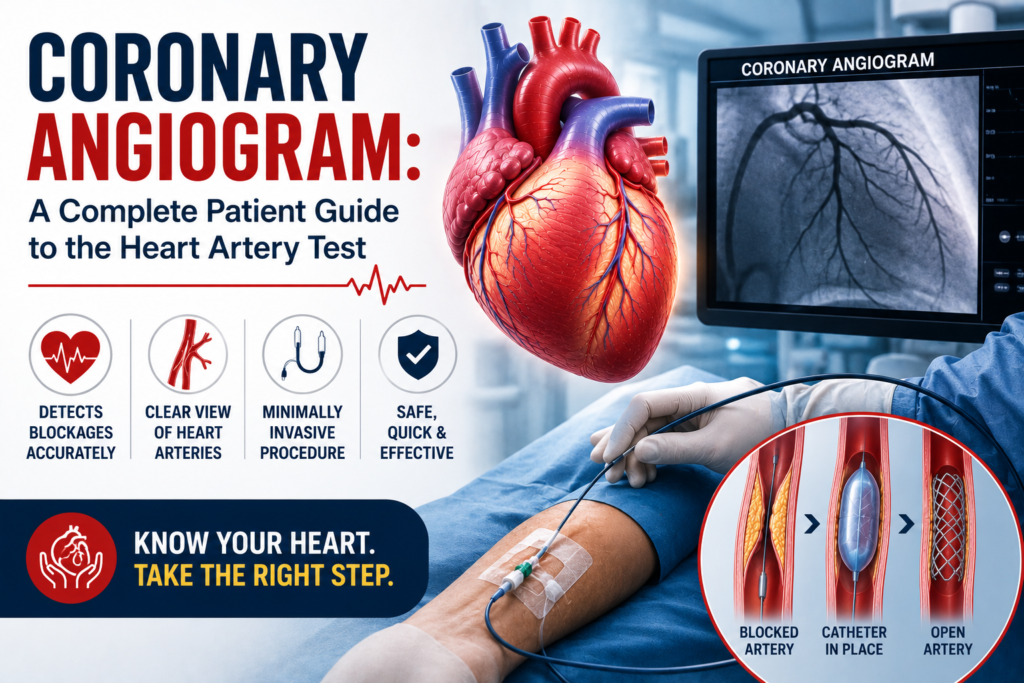



Decades ago, a significant coronary artery blockage almost always meant open-heart bypass surgery — a major operation requiring weeks of recovery. Today, the same blockage can often be treated within an hour using a catheter thinner than a drinking straw, through a small puncture in the wrist, while the patient lies awake. This revolutionary treatment is called coronary angioplasty — and it has transformed cardiac care across the world, saving millions of lives each year.
If your cardiologist has recommended coronary angioplasty, or if you want to understand this procedure before making an informed decision, this comprehensive guide by Dr. T. Sandeep — Interventional Cardiologist at Jayam Hrudayalaya — covers every aspect of coronary angioplasty in complete clinical detail.
What is Coronary Angioplasty?
Coronary angioplasty is a minimally invasive cardiac procedure used to open narrowed or blocked coronary arteries and restore normal blood flow to the heart muscle. It is performed in a catheterisation laboratory (cathlab) by an interventional cardiologist using a thin, flexible catheter inserted through a small arterial puncture — most commonly at the wrist (radial artery).
The term coronary angioplasty combines “coronary” (relating to the heart’s own blood supply arteries) with “angioplasty” (from the Greek words “angio” meaning vessel and “plasty” meaning to mould or reshape). The procedure physically reshapes the blocked artery from within by compressing the obstructing plaque against the vessel wall and, in most cases, placing a metallic scaffold called a stent to keep the artery permanently open.
Coronary angioplasty is also known by several clinical names:
- PCI — Percutaneous Coronary Intervention
- PTCA — Percutaneous Transluminal Coronary Angioplasty
- Stenting — when a stent is placed during the procedure
- Primary PCI — when performed as emergency treatment for a heart attack
How Coronary Angioplasty Works: The Physiology Behind the Procedure
To fully appreciate coronary angioplasty, understanding why coronary arteries block is essential.
Over years and decades, a combination of high cholesterol, high blood pressure, diabetes, smoking, and inflammation causes fatty deposits called atherosclerotic plaques to accumulate inside the coronary artery wall. As these plaques grow, they progressively narrow the vessel lumen — reducing blood flow to the heart muscle.
When the narrowing reaches approximately 70% of the vessel diameter, blood flow becomes haemodynamically significant — meaning the artery can no longer supply adequate oxygen to the heart muscle during physical exertion. This causes the characteristic symptom of angina — chest pain or tightness during activity that subsides with rest.
In a heart attack (myocardial infarction), a plaque ruptures suddenly, triggering a blood clot that completely blocks the artery within minutes — cutting off all blood supply to the region of heart muscle that artery feeds.
Coronary angioplasty directly addresses this problem: the catheter-delivered balloon compresses the plaque, the stent holds the vessel open, and blood flow is restored — eliminating ischemia, relieving angina, and in heart attack treatment, salvaging the threatened heart muscle before permanent damage occurs.
Balloon Angioplasty How It Works: Step-by-Step Mechanism
Understanding balloon angioplasty how it works mechanically helps patients appreciate exactly what happens inside their arteries during the procedure.
The Balloon Catheter System
The working tool of coronary angioplasty is the balloon catheter — an extraordinarily engineered device consisting of:
- Guide wire — A hair-thin wire (0.014 inches in diameter) that is carefully navigated through the coronary artery and across the blockage under X-ray guidance, acting as a rail for all subsequent devices
- Balloon catheter — A thin catheter with a deflated, precisely sized balloon at its tip, threaded over the guide wire to the exact location of the blockage
- Inflation syringe — Used to inflate the balloon to a precise pressure (typically 8–16 atmospheres) to expand the blocked segment
The Inflation Sequence
- The balloon catheter is positioned precisely across the narrowed segment, confirmed by X-ray fluoroscopy
- The balloon is inflated — typically for 30–60 seconds — to a predetermined pressure
- Inflation crushes the atherosclerotic plaque against the artery wall and stretches the vessel to its intended diameter
- The balloon is deflated and the catheter withdrawn
- In virtually all modern coronary angioplasty cases, a stent is then deployed to maintain the vessel opening
PTCA Stent Placement Heart: The Modern Standard of Coronary Angioplasty
Modern coronary angioplasty is almost always combined with PTCA stent placement heart — the deployment of a metallic stent inside the coronary artery to maintain its patency long-term.
What is a Coronary Stent?
A coronary stent in heart artery is a small, expandable mesh-like metallic scaffold — typically made of stainless steel or cobalt-chromium alloy — that is crimped onto the balloon catheter in a compressed form and deployed inside the artery when the balloon inflates.
When the balloon expands, the stent expands with it and embeds into the artery wall. When the balloon is deflated and removed, the stent remains permanently in place — acting as an internal scaffolding that keeps the previously blocked artery open.
Types of Coronary Stents
Bare Metal Stent (BMS) An early generation stent made purely of metal, without any drug coating. Bare metal stents have largely been replaced in modern practice due to a higher rate of restenosis (re-narrowing) compared to drug-eluting stents.
Drug Eluting Stent Angioplasty — The Current Gold Standard
The drug eluting stent angioplasty represents the most significant advance in coronary stent technology. A drug eluting stent (DES) is a metallic stent coated with a polymer that gradually releases an antiproliferative drug (most commonly everolimus, zotarolimus, or sirolimus) over several weeks after implantation.
This drug locally inhibits the excessive cell growth inside the stent that would otherwise cause restenosis — significantly reducing the risk of re-narrowing from approximately 20–30% with bare metal stents to less than 5–8% with modern drug-eluting stents.
The drug eluting stent angioplasty has transformed the long-term outcomes of coronary angioplasty, making it a genuinely durable treatment for the majority of coronary lesions.
Coronary Angioplasty Procedure India: The Complete Step-by-Step Guide
The coronary angioplasty procedure India follows the same internationally standardised protocol used in advanced cardiac centres worldwide. Here is the complete procedure from preparation to discharge:
Pre-Procedure Preparation
- Fasting for 4–6 hours before the procedure
- Antiplatelet medications — dual antiplatelet therapy (aspirin + clopidogrel or ticagrelor) is given before the procedure to prevent clot formation around the stent
- Blood tests (kidney function, blood counts, coagulation) are checked
- An intravenous line is placed for medication administration
- Written informed consent is obtained after a detailed discussion of the procedure, risks, and benefits
Entering the Cathlab
You are positioned on the cathlab table. ECG, blood pressure monitoring, and pulse oximetry are connected. The coronary angioplasty is performed under local anaesthesia at the access site — you remain awake throughout.
Guide Wire Crossing
After the diagnostic angiogram confirms the target lesion, a guide wire is carefully advanced through the coronary artery and across the blockage under fluoroscopic guidance. This is the most technically demanding step — crossing a severely narrowed or totally occluded artery requires precision and experience.
Pre-Dilation (if required)
In very tight or calcified lesions, a small balloon catheter is used to pre-dilate the blockage before stent delivery, creating space for the stent to pass and expand optimally.
Stent Deployment
The drug-eluting stent, pre-mounted on its delivery balloon, is advanced over the guide wire and positioned precisely across the entire length of the target lesion. The balloon is inflated at high pressure — expanding the stent against the artery wall — and then deflated and removed, leaving the stent permanently in place.
Post-Dilation
A high-pressure non-compliant balloon is often inflated inside the deployed stent to ensure it is fully expanded against the vessel wall — optimising stent apposition and minimising the risk of stent thrombosis (clot formation within the stent).
Final Angiography
Contrast dye is injected to perform final angiographic assessment. The cardiologist confirms that the stented segment is fully open, blood flow has been completely restored (TIMI 3 flow), and no complications have occurred.
Closure and Recovery
The arterial sheath is removed and haemostasis achieved. With radial access, a wrist compression band is applied for 2–3 hours. You are transferred to the recovery ward or cardiac care unit for monitoring.
Heart Attack Treatment Angioplasty: Saving Lives in a Medical Emergency
The most dramatic and life-saving application of coronary angioplasty is as heart attack treatment angioplasty — specifically in the management of ST-Elevation Myocardial Infarction (STEMI), the most severe type of heart attack.
Understanding STEMI
In a STEMI, a coronary artery is completely and abruptly blocked by a thrombus (blood clot), cutting off all blood supply to the heart muscle territory that artery supplies. Without treatment, this heart muscle begins to die within 20–40 minutes of the onset of complete occlusion.
Every minute that passes without restoring blood flow means more heart muscle permanently destroyed, more scar tissue, weaker heart function, and higher risk of heart failure and death.
STEMI Primary Angioplasty: The Fastest Life-Saving Treatment
STEMI primary angioplasty — also called Primary PCI — is the international standard of care for heart attack treatment. It involves performing emergency coronary angioplasty as the first-line treatment for STEMI, within the shortest possible time from the patient’s arrival at a cathlab-equipped cardiac centre.
Key time targets in STEMI primary angioplasty:
- Door-to-balloon time — the time from hospital arrival to balloon inflation in the blocked artery — should ideally be less than 90 minutes
- Every 30-minute reduction in door-to-balloon time is associated with a measurable reduction in mortality
- Patients treated within 60–90 minutes of symptom onset have the best outcomes, with minimal permanent heart muscle loss
During STEMI primary angioplasty, the cardiologist performs emergency coronary angiogram to identify the culprit artery, crosses the occlusion with a guide wire, aspirates the fresh clot (thrombus aspiration), and deploys a drug-eluting stent — all in a single emergency procedure, often completed within 45–60 minutes.
The survival benefit of STEMI primary angioplasty over all alternative treatments has been demonstrated in hundreds of clinical trials — it is unquestionably the most effective treatment available for a heart attack when performed promptly.
Angioplasty vs Bypass Surgery: Choosing the Right Treatment
The angioplasty vs bypass surgery decision is one of the most important and nuanced choices in cardiac medicine. Both are effective treatments for coronary artery disease — but they are suited to different anatomical and clinical situations.
Coronary Angioplasty (PCI)
- Minimally invasive — no incision, no general anaesthesia, no chest opening
- Faster recovery — typically discharged within 1–2 days
- Lower immediate risk — less trauma to the body
- Best for: Single or double vessel disease, focal blockages, STEMI emergencies, patients unsuitable for surgery
- Limitation: May not be ideal for very complex multi-vessel disease or left main stem involvement in certain anatomical patterns
Coronary Artery Bypass Grafting (CABG — Bypass Surgery)
- Open-heart surgery — requires general anaesthesia, sternotomy, cardiopulmonary bypass
- Longer recovery — 6–8 weeks
- Higher immediate risk — but excellent long-term outcomes in complex disease
- Best for: Triple-vessel disease, left main stem disease, diabetics with complex multi-vessel involvement, heavily calcified or diffuse disease unsuitable for stenting
The SYNTAX Score
Modern cardiologists use a scoring system called the SYNTAX score — derived from the coronary angiogram — to objectively quantify the complexity of coronary artery disease and guide the angioplasty vs bypass surgery decision with evidence-based precision. Complex, high-SYNTAX-score disease in diabetic patients often favours bypass surgery; simpler disease with lower scores is well-treated by coronary angioplasty.
The decision is ideally made by a Heart Team — a collaborative discussion between the interventional cardiologist and cardiac surgeon — ensuring every patient receives the most appropriate treatment for their specific anatomy.
Angioplasty Success Rate India: What the Evidence Shows
Angioplasty success rate India data mirrors global outcomes from high-volume centres, reflecting the quality of interventional cardiology now available across the country.
Procedural Success:
- Technical procedural success (achieving less than 20% residual stenosis with restoration of normal blood flow): > 95% in elective cases
- For STEMI primary angioplasty: > 90% procedural success at experienced centres
- For Chronic Total Occlusions (CTOs — completely blocked arteries): Success rates range from 70–85% depending on complexity and operator experience
Clinical Outcomes:
- Freedom from major adverse cardiac events (MACE — death, heart attack, repeat revascularisation) at 1 year: approximately 85–90% with modern drug-eluting stents
- Stent restenosis rate (re-narrowing requiring repeat treatment) with drug-eluting stents: 5–8% at 1 year
- Stent thrombosis rate (blood clot within the stent): < 0.5% when dual antiplatelet therapy is maintained as prescribed
These angioplasty success rate India figures from experienced interventional cardiology centres are comparable to outcomes reported in leading cardiac centres internationally, reflecting the genuine advancement of cardiac intervention in India over the past two decades.
Angioplasty Recovery Time: What to Expect After Your Procedure
Angioplasty recovery time is remarkably short compared to the severity of the condition being treated — one of the most compelling advantages of coronary angioplasty over surgical alternatives.
Immediate Recovery (First 24–48 Hours):
In the hospital:
- After the procedure, you are monitored in the cardiac care unit or recovery ward for 12–24 hours
- Heart rate, blood pressure, ECG, and the access site are continuously monitored
- You can eat and drink within 2–4 hours of the procedure
- An echocardiogram may be performed to assess heart function
Discharge:
- Elective coronary angioplasty patients are typically discharged within 24–48 hours
- STEMI patients may stay 3–5 days depending on clinical condition and heart function
Short-Term Recovery (First 2 Weeks):
- Physical activity: Light walking from day 2–3; avoid strenuous activity, heavy lifting, and vigorous exercise for 2 weeks
- Driving: Avoid for minimum 48 hours after elective procedure; 1 week after STEMI
- Work: Desk workers may return to work within 3–7 days; those with physical jobs should wait 2–4 weeks
- Access site care: The wrist puncture site heals within 5–7 days; avoid submerging in water for 48 hours
Long-Term Recovery and Lifestyle:
- Dual antiplatelet therapy — aspirin plus a second antiplatelet drug (clopidogrel or ticagrelor) — must be taken without interruption for a minimum of 6–12 months after drug-eluting stent placement. Stopping these medications prematurely is one of the most serious risks after coronary angioplasty, as it dramatically increases the risk of stent thrombosis
- Statins — cholesterol-lowering medications must be continued long-term regardless of cholesterol levels, as they stabilise coronary plaques beyond their lipid-lowering effect
- Cardiac rehabilitation — structured exercise and lifestyle modification programmes significantly improve long-term outcomes
- Follow-up visits — typically at 1 month, 3 months, 6 months, and 1 year post-procedure, with TMT or other stress testing as directed
Life After Coronary Angioplasty: Lifestyle Changes That Protect Your Stent
The stent itself is an extraordinary piece of technology — but it cannot prevent new plaque from forming in other parts of the coronary circulation, nor can it reverse the underlying atherosclerotic disease process. Only sustained lifestyle modification and consistent medication adherence can accomplish that.
Essential Post-Coronary Angioplasty Lifestyle Changes:
Diet:
- Mediterranean-style diet rich in vegetables, fruits, whole grains, fish, and olive oil
- Strict restriction of saturated fats, trans fats, refined sugars, and processed foods
- Reduction of salt intake to less than 5 grams per day for blood pressure management
Physical Activity:
- Minimum 150 minutes of moderate-intensity aerobic exercise per week — brisk walking, cycling, swimming
- Cardiac rehabilitation programme attendance strongly recommended for the first 3–6 months
Smoking:
- Complete and immediate cessation. Smoking after coronary angioplasty dramatically increases the risk of stent thrombosis and disease progression. There is no safe level of tobacco use after cardiac intervention.
Diabetes and Blood Sugar Management:
- Tight blood glucose control (target HbA1c < 7%) significantly reduces the risk of restenosis and new lesion formation after coronary angioplasty
Blood Pressure and Cholesterol:
- Target blood pressure below 130/80 mmHg
- LDL cholesterol target below 70 mg/dL (or below 55 mg/dL in very high-risk patients)
Stress Management:
- Chronic psychological stress is an independent cardiovascular risk factor; meditation, yoga, and structured relaxation practices contribute to improved cardiac outcomes
Why Expert Interventional Cardiology Matters in Coronary Angioplasty
The outcome of coronary angioplasty is directly influenced by the technical expertise of the interventional cardiologist performing the procedure. Complex lesion preparation, precise stent sizing and positioning, optimal post-dilation, and intravascular imaging-guided implantation all require years of specialised training and high procedural volume.
At Jayam Hrudayalaya — serving patients from across the Vijayanagara region with its dedicated cathlab facility in Hosapete — every coronary angioplasty procedure is performed by Dr. T. Sandeep (MBBS, MD, DNB Cardiology), an experienced interventional cardiologist trained in complex coronary intervention, STEMI primary angioplasty, and complete percutaneous coronary revascularisation. Patients receive internationally standardised cardiac catheterisation care without the need to travel to metropolitan centres.
Coronary Angioplasty: When It Is Not the Right Choice
While coronary angioplasty is the optimal treatment for the majority of coronary artery disease presentations, there are specific situations where it is not the preferred approach:
- Heavily calcified, tortuous vessels — may require rotational atherectomy (Rotablator) before stenting, available only at high-volume centres
- Left main stem disease with complex anatomy — cardiac surgery often preferred, particularly in diabetic patients with triple-vessel involvement
- Diffuse, long-segment disease — bypass surgery may provide more complete revascularisation with better long-term outcomes
- Very poor ventricular function — haemodynamic support devices and multidisciplinary surgical-interventional planning required
These decisions are never made unilaterally — the most appropriate treatment for every patient is determined through a detailed analysis of their coronary angiogram, clinical status, comorbidities, and personal preferences.
Conclusion
Coronary angioplasty is one of the most transformative medical innovations of the twentieth century — a procedure that has converted a life-threatening cardiac emergency into a manageable, minimally invasive intervention with rapid recovery, excellent outcomes, and a genuinely life-extending impact.
Whether you are facing an elective coronary angioplasty for stable angina, an urgent procedure for a positive stress test, or an emergency STEMI primary angioplasty for a heart attack, the procedure offers a safe, proven, and effective path to restored coronary blood flow, relieved symptoms, and renewed cardiac health.
Understanding the procedure, committing to your medications, and embracing the lifestyle changes that protect your newly opened artery are the three pillars of long-term success after coronary angioplasty. With these three elements in place, most patients return to full, active, productive lives — often with better cardiac health than they had for years before their blockage was discovered and treated.