



Coronary
Angioplasty
(PTCA)
A life-saving minimally invasive procedure to open blocked coronary arteries — restoring blood flow to your heart without open-chest surgery.
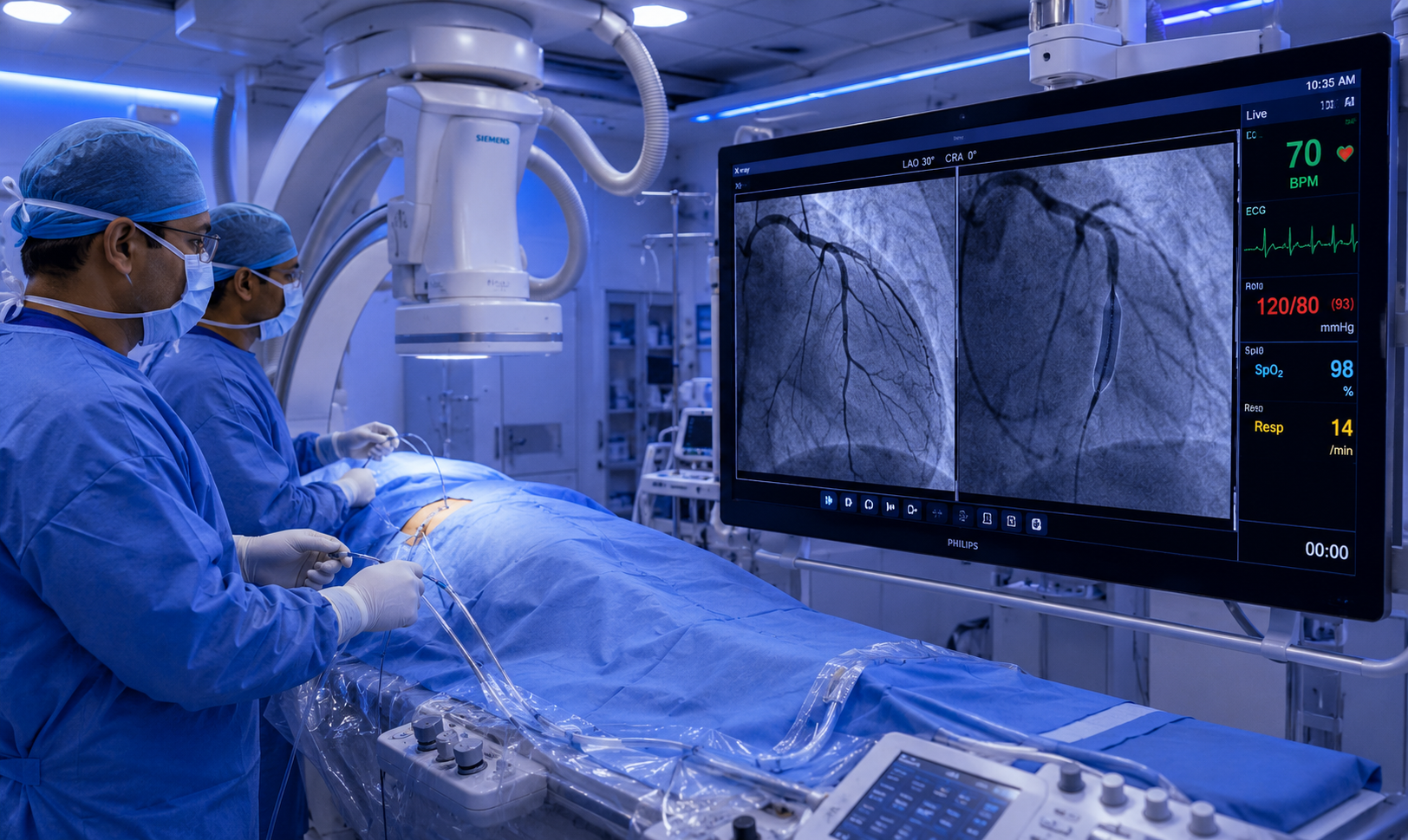
Primary PCI · 24×7 Ready
Understanding the Procedure
What is Coronary Angioplasty?
Coronary Angioplasty, also called Percutaneous Transluminal Coronary Angioplasty (PTCA) or Percutaneous Coronary Intervention (PCI), is a minimally invasive cardiac procedure used to open narrowed or blocked coronary arteries — the vessels that supply blood and oxygen to the heart muscle.
During the procedure, a cardiologist guides a thin flexible tube (catheter) through a small incision — usually at the wrist (radial) or groin (femoral) — up into the coronary artery. A tiny balloon at the tip is inflated to compress the fatty plaque and widen the artery. In most cases, a metal mesh tube called a stent is then placed to keep the artery open permanently.
At Jayam Hrudayalaya, angioplasty is performed using state-of-the-art catheterisation laboratory (cath lab) technology, ensuring precision, safety, and rapid recovery for every patient — including 24×7 emergency primary PCI for acute heart attack.
Also Known As
PTCA (Percutaneous Transluminal Coronary Angioplasty), PCI (Percutaneous Coronary Intervention), Balloon Angioplasty, Stenting
Performed By
Interventional Cardiologist in a dedicated Cath Lab under fluoroscopic guidance with real-time X-ray imaging
Anaesthesia
Local anaesthesia at access site only; patient remains awake and comfortable throughout the entire procedure
Hospital Stay
Typically 24–48 hours post-procedure for monitoring; radial (wrist) access often allows same-day discharge in stable patients
Access Routes
Transradial (wrist) — preferred for fewer complications and faster recovery; Transfemoral (groin) — used in complex or urgent cases
Step by Step
How the Procedure is Performed
Preparation & Access
The access site (wrist or groin) is cleaned and numbed with local anaesthesia. A small sheath is inserted into the artery to provide a pathway for catheters. The patient is awake but comfortable throughout.
Catheter Advancement
A guiding catheter is threaded through the sheath and carefully navigated through the aorta to the entrance of the coronary artery, monitored live via X-ray fluoroscopy and contrast dye injections.
Guidewire Crossing
A very thin guidewire (0.014 inches) is advanced through the guiding catheter and carefully crossed through the blockage (stenosis) inside the coronary artery, creating a rail for subsequent devices.
Balloon Inflation
A balloon catheter is advanced over the guidewire to the blockage site. The balloon is inflated for 20–60 seconds at high pressure (6–20 atmospheres), compressing the plaque against the artery wall to widen the passage.
Stent Deployment
A stent — crimped onto a balloon catheter — is positioned at the treated site and expanded by inflating the balloon. The stent springs open and permanently scaffolds the artery, preventing it from collapsing again.
Verification & Closure
Final angiogram images confirm successful blood flow restoration. All catheters are removed, the access site is closed with a pressure band or suture, and the patient is shifted to the recovery unit.
Procedure Variants
Types of Coronary Angioplasty
Plain Old Balloon Angioplasty (POBA)
The original technique involving only balloon inflation without stent placement. Now rarely used alone but still employed in specific small vessels or as pre-dilatation before stenting.
- Used for small or side-branch vessels
- Pre-dilatation before stent delivery
- Lower cost; suitable in selected cases
- Higher restenosis rate than stenting
Bare Metal Stent (BMS) PCI
A metal mesh stent without any drug coating, deployed to keep the artery open. Requires dual antiplatelet therapy for at least one month and has a higher re-narrowing rate than drug-eluting stents.
- Shorter antiplatelet therapy duration
- Preferred when bleeding risk is high
- Used when early surgery may be needed
- Less commonly used since DES became standard
Drug-Eluting Stent (DES) PCI
The current gold standard — a stent coated with anti-proliferative drugs that slowly elute into the artery wall to prevent re-narrowing. Significantly lower restenosis rate versus bare metal stents.
- Restenosis rate <5–10% at 1 year
- Requires dual antiplatelets for 6–12 months
- Suitable for long or complex lesions
- Preferred in diabetes and multi-vessel disease
Primary PCI (Emergency Angioplasty)
Performed as the first-line treatment for acute STEMI (heart attack with ST elevation) within 90 minutes of hospital arrival (door-to-balloon time). Most effective therapy to salvage heart muscle.
- Gold standard for STEMI treatment
- Door-to-balloon target: <90 minutes
- Dramatically reduces mortality and infarct size
- Available 24 × 7 at Jayam Hrudayalaya
When is it Recommended?
Indications for Angioplasty
Acute STEMI
Complete occlusion of a coronary artery causing a massive heart attack — primary PCI is the definitive emergency treatment.
Unstable Angina / NSTEMI
Chest pain at rest or worsening pattern, or partial-thickness heart attack requiring urgent catheterisation and revascularisation.
Stable Angina
Significant coronary narrowing (≥70%) causing exertional chest pain despite optimal medical therapy — PCI relieves symptoms reliably.
Positive Stress Test
A TMT or nuclear stress test showing a significant ischaemic area indicating the need for revascularisation in high-risk patients.
Reduced Heart Function
Impaired left ventricular ejection fraction (LVEF <40%) due to ischaemia where restoring blood flow may recover function.
Significant Stenosis on Angiogram
Coronary angiography revealing ≥70% diameter stenosis in a major vessel, especially with fractional flow reserve (FFR) <0.80.
Exercise Intolerance
Inability to perform daily activities due to angina or dyspnoea caused by haemodynamically significant coronary artery disease.
In-Stent Restenosis
Re-narrowing within a previously placed stent, treated with drug-eluting balloon (DEB) or repeat stenting with a drug-eluting stent.
Stent Comparison Guide
Types of Stents Used in Angioplasty
| Stent Type | Material / Coating | Antiplatelet Duration | Restenosis Rate | Best Suited For | Notes |
|---|---|---|---|---|---|
| Bare Metal Stent (BMS) | 316L Stainless steel / Cobalt-chromium — no drug | 1 month | 15–20% | High bleeding risk; pre-surgery patients | Less Common |
| 1st Gen Drug-Eluting Stent | Sirolimus or Paclitaxel — permanent polymer | 12 months | 5–10% | Standard CAD lesions | Older DES |
| 2nd Gen DES (Everolimus) | Cobalt-chromium + Everolimus — biocompatible polymer | 6–12 months | 3–6% | Diabetes, long lesions, small vessels | Current Standard |
| Bioresorbable Scaffold (BRS) | PLLA polymer — dissolves in 2–3 years | 12 months | Variable | Young patients; vessel motion segments | Emerging |
| Drug-Eluting Balloon (DEB) | Paclitaxel-coated balloon — no permanent implant | 1–3 months | 8–12% | In-stent restenosis; small vessels; bifurcations | No Stent Left |
Clinical Considerations
Benefits & Risks of Angioplasty
Benefits of the Procedure
Why angioplasty is recommended over alternatives in appropriate candidates
- ✓Rapid relief of angina and chest pain — most patients experience immediate improvement after stenting
- ✓Minimally invasive — no open-chest surgery; small puncture at wrist or groin only
- ✓Short recovery time — typically back to normal activities within 1–2 weeks
- ✓Saves heart muscle in STEMI — primary PCI reduces infarct size dramatically when performed promptly
- ✓Reduces mortality in acute heart attack settings when performed within time windows
- ✓Improves quality of life and exercise tolerance in stable angina patients
- ✓Lower procedural risk than coronary artery bypass surgery (CABG) for single/double vessel disease
Possible Risks & Complications
Rare but important risks discussed during informed consent
- !Access site haematoma or bleeding — usually minor; rare need for transfusion (<1%)
- !Contrast dye allergic reaction — pre-medication given in allergic patients; very rare severe reaction
- !Contrast-induced nephropathy — temporary kidney function decline, especially with pre-existing kidney disease
- !In-stent restenosis (ISR) — re-narrowing within stent; incidence 5–15% depending on stent type used
- !Stent thrombosis — rare but serious clot within stent (<1%); prevented by uninterrupted antiplatelet drugs
- !Coronary artery dissection or perforation — rare; managed in cath lab immediately by the team
- !Stroke or heart attack during procedure — very rare (<0.5%) in elective cases at experienced centres
Before the Procedure
How to Prepare for Angioplasty
Fasting Instructions
Fast for at least 4–6 hours before an elective procedure. For emergency angioplasty (Primary PCI), this restriction is waived and the team proceeds immediately to save time.
Medications to Inform
Inform your cardiologist about all medications — especially blood thinners (warfarin, aspirin), diabetes drugs (metformin must be stopped 48 hrs prior), and NSAIDs. Never stop medications without explicit advice.
Antiplatelet Pre-loading
A loading dose of dual antiplatelet therapy (aspirin + clopidogrel or ticagrelor) is given before or during the procedure to reduce clot risk inside the stent during and after deployment.
Blood Tests & ECG
Pre-procedure workup includes complete blood count, kidney function tests (creatinine), coagulation profile, blood group, ECG, and echocardiogram if not recently performed.
IV Access & Monitoring
An IV line is placed for medications and fluids. Continuous ECG monitoring, pulse oximetry, and blood pressure monitoring are set up before you enter the cath lab for the procedure.
Informed Consent
The cardiologist will explain the procedure, benefits, risks, and alternatives in detail. You and your family will be given adequate time to ask questions before signing the consent form.
Post-Procedure Care
Recovery After Angioplasty
In Hospital (First 24–48 Hours)
You will be monitored in the cardiac care unit or step-down unit. A compression band or pressure dressing is applied at the access site. ECGs and blood tests are repeated to confirm procedure success. Most patients walk within a few hours of radial (wrist) access procedures.
Medications After Discharge
Dual antiplatelet therapy (aspirin + a P2Y12 inhibitor such as clopidogrel or ticagrelor) is mandatory — typically for 6–12 months after DES. Statins, beta-blockers, and ACE inhibitors are also continued as prescribed. Never stop antiplatelets without consulting your cardiologist.
Activity & Return to Work
Avoid heavy lifting or strenuous activity for 1–2 weeks after radial access; 2–3 weeks after femoral access. Most patients with desk jobs return to work within 5–7 days. Driving can usually be resumed after 1 week once the access site has healed and the cardiologist confirms it is safe.
Long-term Follow-up & Lifestyle
Follow-up visits at 1 month, 6 months, and 12 months are essential. Adopt a heart-healthy lifestyle: Mediterranean-type diet, regular moderate exercise (30 min most days), smoking cessation, weight control, and strict management of diabetes, hypertension, and cholesterol. Angioplasty treats the blockage — not the underlying disease.
Frequently Asked Questions
The procedure itself is not painful. Local anaesthesia numbs the access site, so you will feel only a small sting during the injection. You remain awake throughout and may feel mild pressure during catheter movements, but not sharp pain. Some patients feel a warm flush when contrast dye is injected, which is brief and normal. If you feel chest discomfort during balloon inflation, it typically lasts only seconds and resolves immediately when the balloon is deflated.
A routine single-vessel elective angioplasty with stenting typically takes 30–60 minutes. Complex cases involving multiple vessels, calcified lesions, or bifurcation (branching) lesions may take 1–2 hours. Emergency primary PCI for heart attack is performed as rapidly as possible — the target is to restore blood flow within 90 minutes of hospital arrival (door-to-balloon time). You will be in the cath lab for this duration, then moved to the recovery unit.
Angioplasty (PCI) is minimally invasive — no chest opening, no heart-lung bypass machine, quicker recovery (days vs weeks), and performed under local anaesthesia. Coronary artery bypass grafting (CABG) is open-heart surgery where a graft vessel is stitched to bypass the blockage. CABG is preferred for left main disease, three-vessel disease especially with diabetes, or when lesions are too complex for stenting. For single or double vessel disease, PCI and CABG have comparable long-term outcomes; your cardiologist will advise the best option based on your specific anatomy and clinical situation.
Yes — re-narrowing called in-stent restenosis (ISR) can occur, though modern drug-eluting stents have reduced this to under 5–10% at one year. A rare but more serious complication is stent thrombosis — a clot forming inside the stent — which is why uninterrupted dual antiplatelet therapy is critical and must never be stopped without cardiologist advice. The risk of blockage in other arteries also continues if underlying risk factors (smoking, diabetes, hypertension, high cholesterol) are not controlled through lifestyle changes and medications.
At Jayam Hrudayalaya, coronary angioplasty is available under government BPL (Below Poverty Line) schemes, providing access to life-saving interventions for patients who otherwise cannot afford treatment. We also accept most major insurance policies. Our administrative team will help you with pre-authorisation, documentation, and claim processing. Please contact us or visit the BPL Scheme page on our website for eligibility criteria and the required documents. No patient should be denied life-saving cardiac care due to financial constraints.
Call emergency immediately (+91 89719 85767) or go to the nearest emergency if you experience: chest pain or tightness (even mild), severe shortness of breath, palpitations or rapid heartbeat, dizziness or fainting, sudden sweating, or pain radiating to the jaw, shoulder, or arm. These may indicate a stent blockage or another cardiac event. Do not wait to see if it improves. Also seek urgent care if you notice heavy bleeding, swelling, or a pulsating lump at the catheter insertion site after discharge from hospital.